On Caravaggio’s “Seven Works of Mercy”
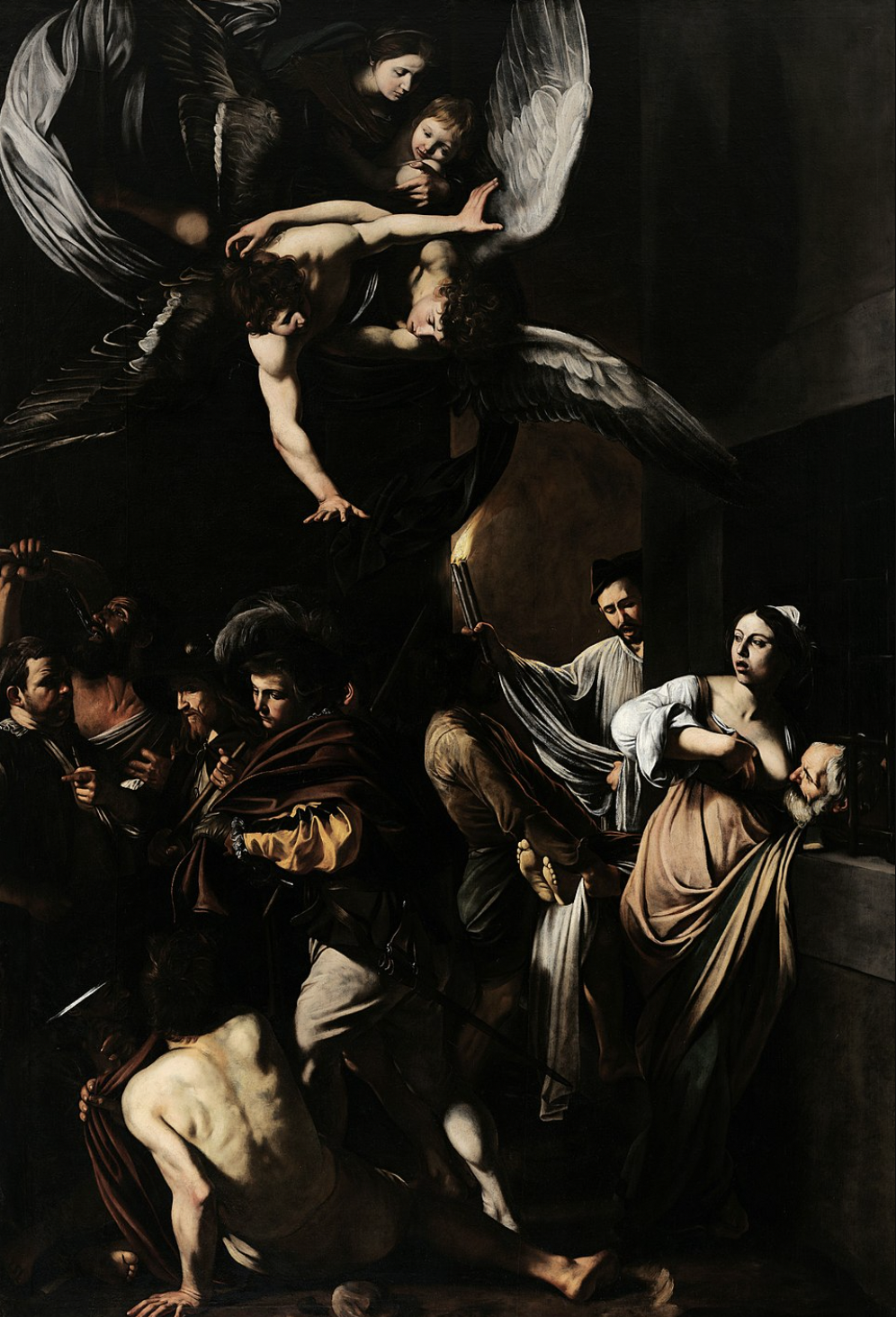
This past summer, I had the wonderful pleasure of seeing over three dozen Caravaggio paintings in Florence, Rome, and Naples, including at the Palazzo Barberini’s major exhibition. Perhaps my favorite painting of his, the one that invited me on a sort of pilgrimage to Naples, is his Sette opere di misericordia, or Seven Works of Mercy, from 1607. This painting features Caravaggio’s signature style of chiaroscuro, the stark contrast of light and shade, and it depicts in a single image the seven corporal works of mercy traditional to Christianity: feeding the hungry, sating the thirsty, sheltering the stranger, clothing the naked, tending the sick, visiting the imprisoned, and burying the dead. Where prior artists through the centuries had painted individual scenes for each work of mercy, Caravaggio uniquely brought all seven together in a single painting for the first time.
I love this Caravaggio for both aesthetic and historical reasons, for what it can tell us about both art and history. On purely aesthetic grounds, it satisfies the three properties of beauty, at least as defined by medieval thinkers like Thomas Aquinas: These are integritas, consonantia, and claritas. The first of these, integritas, or wholeness, refers to the unity of a given object, to that object’s completeness. It has nothing missing. With this painting, there is a single dramatic scene conveying a singular dramatic message, one of mercy. The second of these criteria, consonantia, refers to the overall harmony among the given object’s various parts. The parts are proportional to one another, and each complements the other. In this Caravaggio, each part—whether considering the individual bodies or each act of mercy (some of which double up, as in the lady feeding the prisoner)—dances with the other. Finally, and perhaps most importantly, claritas refers to the radiance of that given object. It’s the property that invites the viewer in, the attractiveness that does the attracting, the thing’s aura, as the kids say. In this painting, aside from the fact that the use of chiaroscuro is providing some of the literal claritas, there is a dynamism in the drama unfolding and a meaningfulness in the mercy responding to misery that combine with the other two properties to make for an overall beautiful work of art.
(As an aside, I have been using the word object to refer to the generic thing of beauty. But in reality, the beautiful thing acts more as a subject, and we are the true objects in the face of its beauty. It acts upon us. It stops us in our tracks and arrests our senses. Yes, we in turn use our senses to process and interpret that beauty and act to further its harmonization. But it’s a reaction to the beautiful thing acting upon us first. And as a further aside, the Spanish “me gusta” and Italian “mi piace” capture this underlying dynamic much better than the English “I like it.”)
Aside from its aesthetic merit, I also love how deeply seeped in history this painting is. But first, it may help to consider the following reflection from historian Hayden White on seeing history as a language. From Metahistory:
The historian confronts the historical field in much the same way that the grammarian might confront a new language. His first problem is to distinguish among the lexical, grammatical, and syntactical elements of the field. Only then can he undertake to interpret what any given configuration of elements or transformations of their relationships mean. In short, the historian’s problem is to construct a linguistic protocol, complete with lexical, grammatical, syntactical, and semantic dimensions, by which to characterize the field and its elements in his own terms (rather than in the terms in which they come leveled in the documents themselves), and thus to prepare them for the explanation and representation he will subsequently offer of them in his narrative.
Any language is composed of layers: There are the discrete words (the lexical), the order in which to place them to give them structure (the grammatical and syntactical), and the overall meaning that results (the semantic). Per White’s analogy, history is similarly composed of such layers, with discrete individuals, institutions, artifacts, works, moments, or phenomena that must then be ordered by the historian, placing them within a broader context, in order to then craft a coherent narrative.
We can use this analogy to approach Caravaggio’s Sette opere on two levels. On the first, more immediate level, we can analyze the painting as a language. Seen lexically, each action taking place in the image forms a base unit: There’s the woman nursing the prisoner on the right, the pair of men carrying a dead body toward the back, the wealthy man giving his cloak to the naked beggar on the ground, etc. Each of these base units is already full of meaning and participating in an historical tradition: For example, with knowledge of the biblical tradition, one can identify Samson in the back left drinking water from the jawbone of an ass; with knowledge of Spanish symbolism, one can notice, next to Samson, the shell on the hat of the pilgrim seeking shelter; knowledge of classical mythology will help us identify the woman as Roman Charity; and that of Christian hagiography tells us the wealthy man is St. Martin of Tours.
Syntactically, taken together, these discrete actions begin to form an ordered scene. In zooming out, we’re able to see that the scene indeed depicts the seven corporal works of mercy. But semantically, what gives the painting any meaning is the fact that it is a bold expression of Counter-Reformation ideology. Less than a century after the start of the Protestant Reformations, which insisted on salvation through faith alone, this painting participated in the Catholic response, which was to reassert the importance of charity—of salvation through faith and works.
Now with the Counter-Reformation in mind, we can use White’s analogy of history as language to approach Caravaggio’s Sette opere on a second, broader level. On this level, his painting simply forms part of the historical moment’s lexicon. There were many other such paintings from this time period from noted artists as El Greco and Murillo. As with the Sette opere, which was commissioned by a Neapolitan brotherhood dedicated to serving the poor, many of these other works of art were similarly commissioned by other churches, brotherhoods, and hospitals throughout Catholic Europe. And these networks of charitable institutions formed the grammar and syntax of their intended charitable activities. On a semantic level, these phenomena can be understood and given meaning only in light of not only the theological conflicts between Protestants and Catholics at the time but also the socioeconomic transformations occurring throughout Western Europe, including increased urbanization and the early developments of capitalism.
Much as a language can reveal its beauty through its own order and the meaning we give it, so can history, even in its darker moments. Indeed, history is best seen as a chiaroscuro. And a beautiful painting like Caravaggio’s Sette opere helps reflect that beauty—and in a fundamentally human way.