On Sovereignty and Human Rights
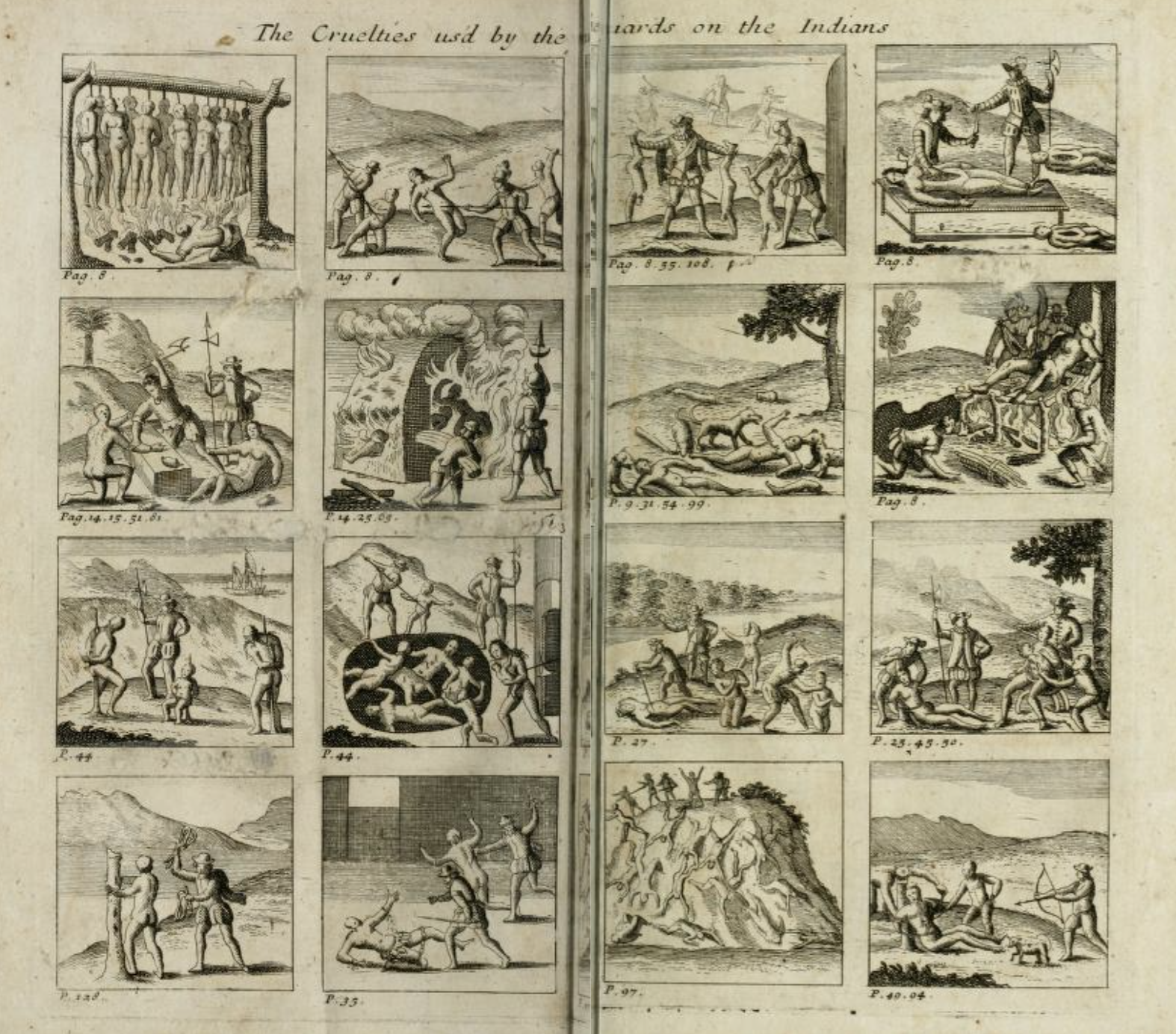
Woodcuts from a 1699 English translation of Bartolomé de las Casas’ Brevísima relación de la destrucción de las Indias, first published in 1552 in Spanish, achieving great influence throughout Europe in the sixteenth century
In the fall of 1550, the Spanish Crown organized one of the most significant debates of early modernity. Participating in this debate on the conquest of the New World were two established polemicists: Bartolomé de las Casas, a Dominican friar who had spent almost half a century in the Americas, and Juan Ginés de Sepúlveda, a jurist and philosopher who had made a name for himself within humanist circles. Their debate revolved around questions of the dictates of natural law, the framework of just war, the dignity of the human person, and the principles of sovereignty. Just over 475 years later, these questions remain as relevant as ever.
Last fall, I participated as a faculty fellow in a semester-long seminar as part of the Mellon-funded public initiative, “Sovereignty and Democracy in Indian Country” at the Oklahoma Center for Humanities. For one of our sessions, I asked my fellow seminar participants to read excerpts from this famed debate as well as a few journal articles expanding upon the matter of jurisdictional politics in the colonial context. For Las Casas, the American kingdoms derived their “legitimate lordship, dignity, and preeminence” directly “from natural law and the law of nations, insofar as that lordship is exercised in the regulation and governance of kingdoms”; consequently, their kingdoms could not be violently subjugated or their peoples, forcefully converted. Sepúlveda, for his part, also appealed to the natural law, but in a much less Thomistic fashion and in a much more Aristotelian vein: The natural law, rather than pointing us to the inherent dignity of each individual and inherent legitimacy of each kingdom, instead underscored the natural hierarchies and inequalities of the world—in this case, “the barbarians of the New World and the adjacent islands, who are as inferior to the Spaniards in prudence, intelligence, virtue, and civilizations as children are to adults and women are to men.” According to Sepúlveda, this natural inferiority made the submission of the Indians by the Spaniards through war and conquest therefore justified.
In the secondary material we read together, we explored several case studies presented by historian Lauren Benton in different colonial contexts, including in British India and Spanish America. As she shows in her analyses, there was an “orderly disorder” that was almost inherent to colonial governance and its legal order, wherein jurisdictional fluidity was not only ubiquitous but also useful for the wide variety of actors—imperial, colonial, and indigenous alike—attempting to exert their own domains of sovereignty. And as Benton shows, this dynamic held globally, whereby “struggles over difference,” especially in legal contexts, not only “gave rise to a global legal order” but also “shaped both local colonial cultures and global structures.”
It is this last insight that has shaped much of a current project of mine, a coedited volume on The Contractual Monarchy of the Iberian World, c. 1500–1700, forthcoming with Brill Publishing. In this volume, my fellow coeditor and I have assembled 17 different studies examining the many corners of the Iberian empires, from Goa and the Philippines to Brazil and the Andes, to show the fundamentally contractual nature of these empires, which relied on negotiation as a principal means of legitimating their power, whether through trade, representation, or cultural exchange. These themes tie into another project of mine, my working manuscript on Poverty in a Golden Age, which looks at the ideas, institutions, and images of poverty throughout the early-modern Spanish empire. This project includes the Americas, where the legal construction of indigenous poverty served as a critical avenue by which to address poverty, both from the imperial perspective and from the indigenous one as well, including indigenous confraternities that worked with imperial authorities for their own betterment.
Today, as we continue to examine questions of overlapping jurisdictions, notions of sovereignty, and human rights in general, the old maxim comes to mind: Plus ça change, plus c’est la même chose.